
WORKING OF HEART
The right atrium receives deoxygenated blood (blood with les oxygen) through two veins: one of carrying blood from upper part of the body and the other from lower part of the body. The left atrium receives oxygenated blood (blood with more oxygen) from lungs.
Both atria contract at the same time and pump the blood from left atrium to left ventricle and from right atrium to right ventricle. The two ventricle contract at the same time. During this contraction, the blood from left ventricle is pumped towards all the body parts (except lungs) through the main artery called aorta and the blood from right ventricle is pumped towards the lungs.
BLOOD VESSELS
The blood vessel that carry blood away from the heart are called arteries. Aorta is the main artery. It branches to from small arteries branch again to from arterioles. The arterioles divide and become tiny vessel called capillaries. Capillaries provide a large surface area for the exchange materials between the blood and the tissue. Capillaries re-unit to form small veins called venules. The venules join to bigger veins. The veins carry blood back to the heart.
STRUCTURE AND FUNVCTION OF BLOOD VESSELS:-
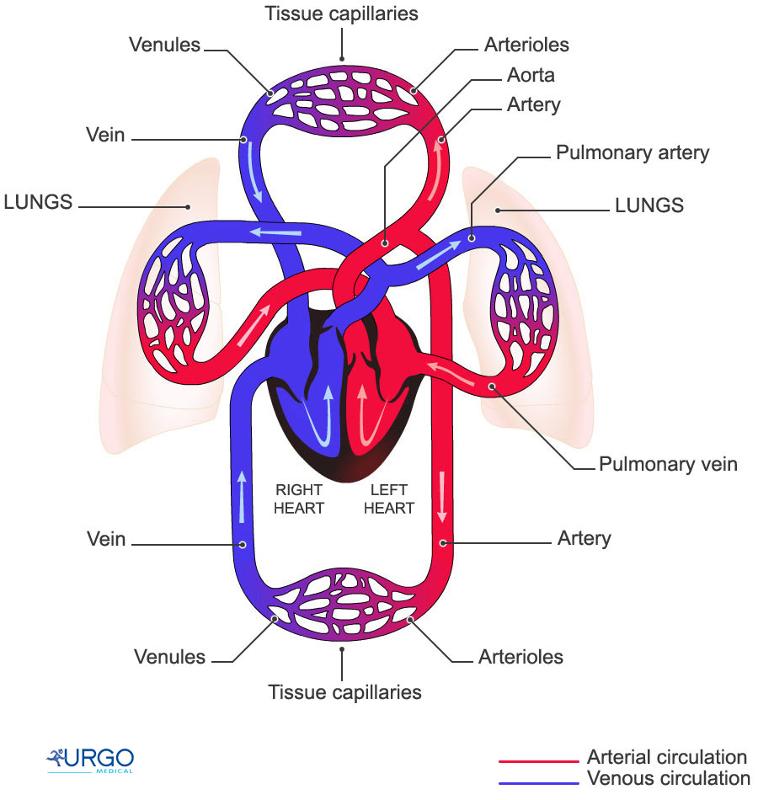
Arteries arte thick-walled. When an artery. Constricts, its lumen (space)becomes narrower and less blood flows through in a given time. Arteries have no valves. In places where the arteries are close to the skin such as wrist one can feel the expansion of the arteries as pulse. The pulse tells us the rate of heart beat. The flows under high pressure in the arteries. When the reaches a vein it flows slowly and smoothly. So the walls of the veins need not be as thick and muscular as those of the arteries. Veins have large lumen. Most of the veins have internal valves to prevent backflow of the blood capillaries are very thin walled vessel through which the exchange of material between blood and tissues takes place.

 175.352 SRY