

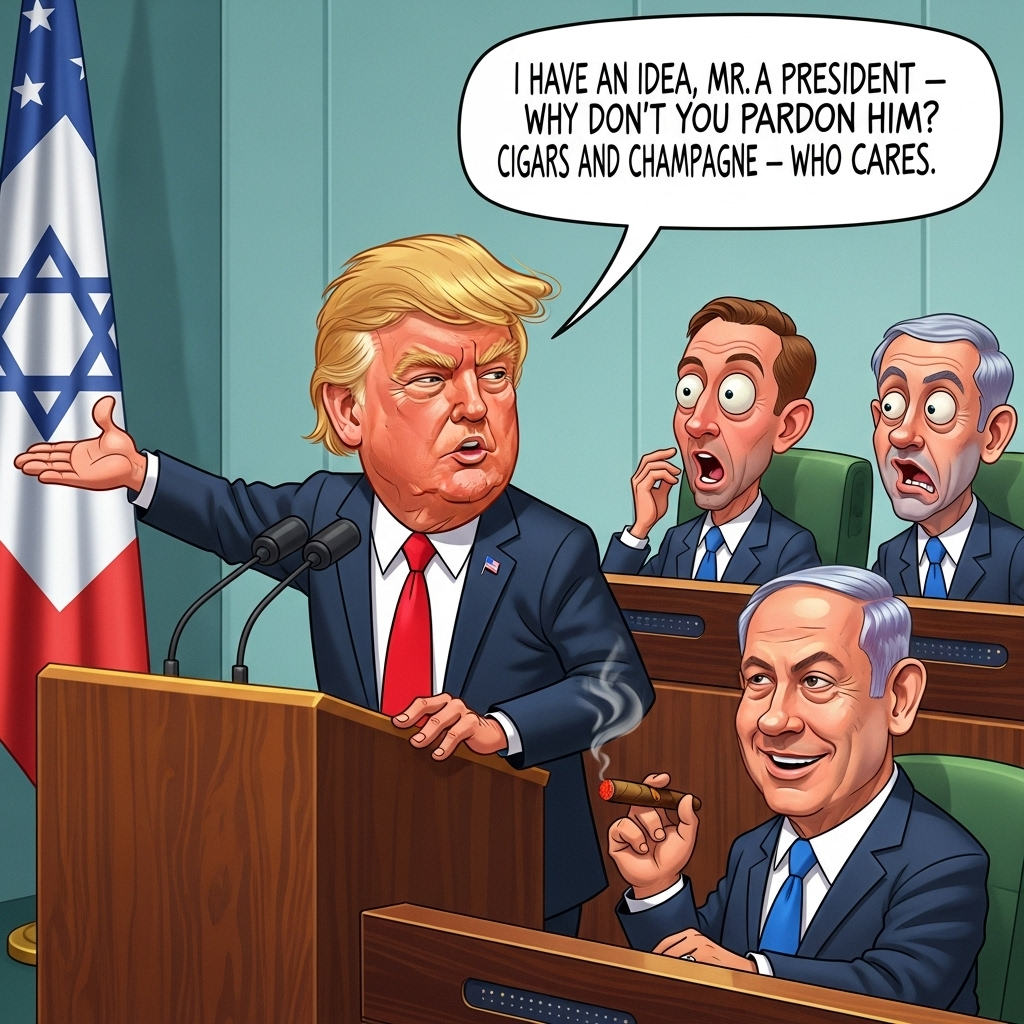
On October 13, 2025, during a speech at the Israeli Knesset, U.S. President Donald Trump called on Israeli President Isaac Herzog to grant a presidential pardon to Prime Minister Benjamin Netanyahu, who faces multiple corruption charges, including bribery, breach of trust, and accepting luxury gifts.
“I have an idea, Mr. President — why don’t you pardon him?” Trump said jokingly during his address. “Cigars and champagne — who cares?”
The remark, though delivered with humor, sparked significant controversy in both Israel and the United States, raising questions about the extent of U.S. interference in Israel’s domestic judicial matters.
🔹Background of Netanyahu’s Corruption Cases
Prime Minister Netanyahu is currently on trial in three separate corruption cases involving bribery, fraud, and breach of trust. He is accused of accepting expensive gifts — including cigars, champagne, and jewelry — from businessmen in exchange for political favors and favorable media coverage.
These cases, first filed in 2019, have been repeatedly delayed due to political instability and regional conflicts.

🔹Political and Diplomatic Dimensions
Trump’s statement marks a notable shift in U.S. foreign policy, from a focus on promoting democratic values and rule of law to emphasizing personal political alliances.The call came amid ongoing political collaboration between Trump and Netanyahu — particularly in negotiations over the recent Gaza ceasefire — highlighting the intertwined relationship between diplomacy and personal loyalty.
In Israel, opposition leaders sharply criticized the remark, arguing that foreign involvement in judicial affairs undermines Israeli sovereignty and the independence of its courts.
Analysts also noted that Trump’s comments fit into a broader strategy of rewarding political allies facing legal or political challenges.
🔹Reactions and Possible Outcomes
Trump’s request triggered mixed reactions in both Israel and abroad.
While Netanyahu’s supporters saw it as a symbolic gesture of solidarity, critics accused Trump of politicizing judicial independence for his own gain.Legal experts stressed that a pardon at this stage is unlikely, as Netanyahu has not yet been convicted — and presidential pardons are typically granted only after a final verdict.
President Herzog, who holds constitutional authority to issue pardons, now faces intense political pressure amid divided public opinion.

🔹Conclusion
Trump’s call for Netanyahu’s pardon underscores the deep political alliance between the two leaders but also reignites debate about the balance between diplomacy and judicial independence.
Observers warn that while the statement may strengthen Netanyahu’s political base, it also risks damaging perceptions of U.S. neutrality in one of its closest Middle Eastern alliances.
🔗 News source : https://www.washingtonpost.com/politics/2025/10/15/trump-netanyahu-pardon-corruption/

Twitter: https://x.com/Robert_Stanb
blurt.blog: https://blurt.blog/@robert.stanberry
serey.io : https://serey.io/authors/robert-stanberry

 544.385 SRY