

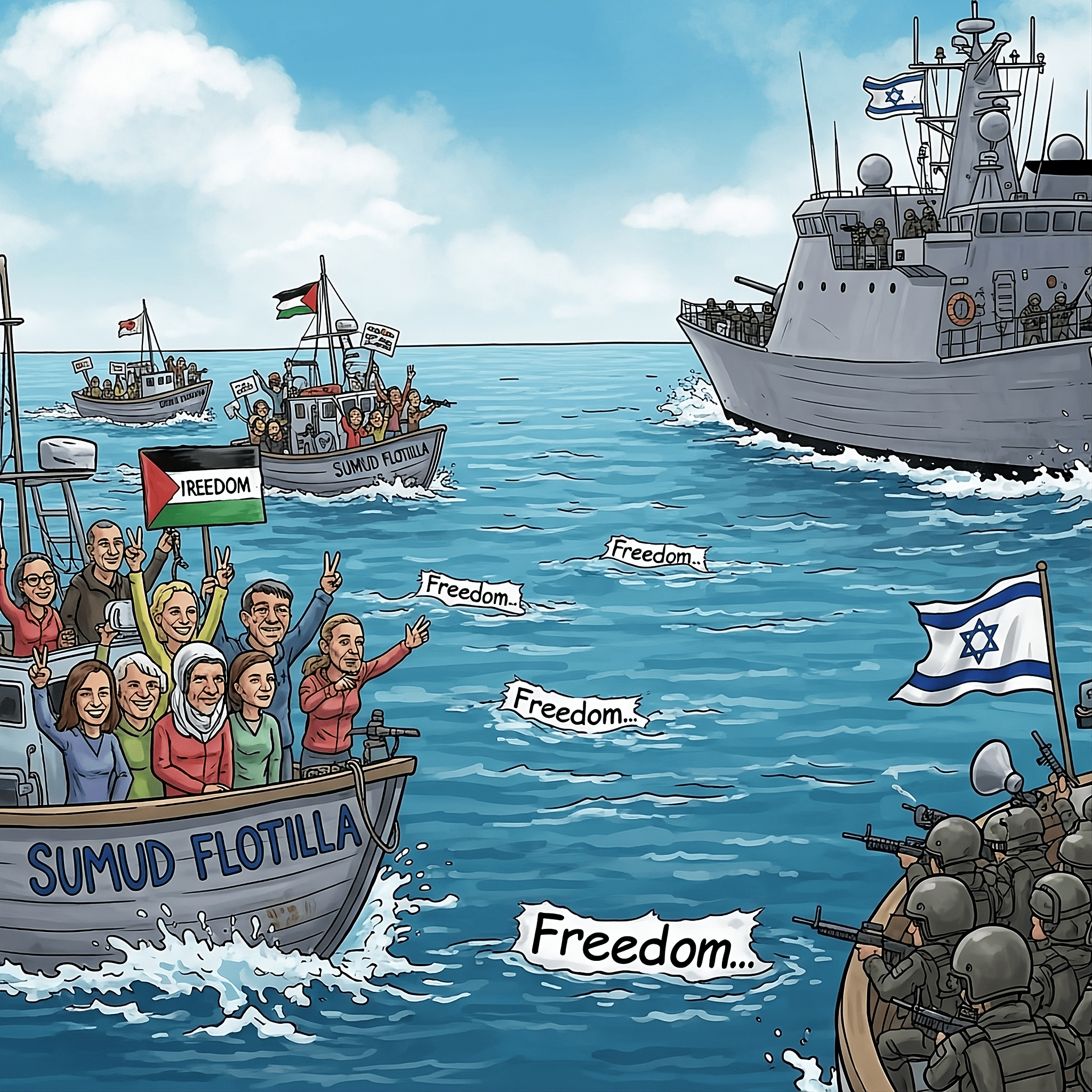
The interception of the Sumud Flotilla’s ships and the arrest of their passengers is nothing but another chapter of maritime piracy carried out by the Israeli entity under the pretext of “security.” What happened was not about defending shores or protecting borders, but rather a blatant violation of international law and an act of organized terrorism targeting every voice that seeks to break the years-long blockade imposed on Gaza.
🔹Arbitrary Arrests Under the Cover of “Security”
The passengers detained by Israeli soldiers were civilian activists, doctors, journalists, and supporters who carried nothing but humanitarian aid and the banners of freedom. Yet they were forcibly dragged into occupied ports as though they were dangerous criminals. This action reveals the truth: “security” is nothing but a false slogan used to justify a repressive policy whose main objective is to criminalize solidarity and isolate Gaza from the world.It is a purely colonial mentality: anyone who extends a hand with food and medicine to Palestinians is treated as an adversary who must be subdued by force.
🔹The Israeli Entity Outside the Law
What took place occurred in international waters, where Israel has no right whatsoever to impose control or arrest passengers. Under international maritime law, this act is classified as piracy. Yet Israel attempts to dress it up with hollow terms such as “security zone” or “naval blockade.” The reality is that these pretexts cannot withstand any legal or humanitarian scrutiny, and they confirm that the Gaza blockade is not merely a policy but a tool of collective punishment and a means of humiliating its residents and those who stand in solidarity with them.
🔹International Reactions: Condemnation Without Deterrence
The countries whose citizens participated in the flotilla rushed to condemn the incident, but their actions remained weak compared to the blatant assault:Italy and Greece warned Israel against the use of violence, but their warnings did not prevent soldiers from storming the ships by force.
Spain dispatched naval vessels for monitoring—no more than a symbolic gesture.
Turkey was the most outspoken, describing the operation as a flagrant violation of international law and freedom of navigation.
Other countries, such as Brazil and Australia, demanded guarantees for the safety of their citizens, but limited themselves to diplomatic statements that fell far short of the gravity of the crime.
These reactions reflect a growing awareness of the danger posed by Israel’s actions, but they also expose the international community’s inability to deter such policies.
🔹The Humanitarian Dimension
Behind all the military maneuvers and political rhetoric lies a simpler reality: humanitarian aid was once again denied entry to Gaza. Every arrest of a supporter, every confiscated shipment of food or medicine, means thousands of families remain under siege without adequate treatment or sufficient nourishment. Israel is not confronting ships, but confronting an idea: the idea that Gaza is not alone, and that the world refuses to accept two million people imprisoned behind maritime barbed wire.Israel may believe it has triumphed by forcing the ships to change course and arresting their passengers. But in truth, what it has brought upon itself is a resounding moral defeat. The images from the sea—heavily armed soldiers facing unarmed activists—will remain a testament to the nature of this entity: one that knows only the language of repression, possesses nothing but the logic of brute force, yet loses the battle of public opinion day after day.
The policy of arrests and repression will not stop the Flotillas of Freedom. Rather, it will make them more determined, and further expose Israel’s isolation—from humanity, and from the law.

 178.709 SRY