

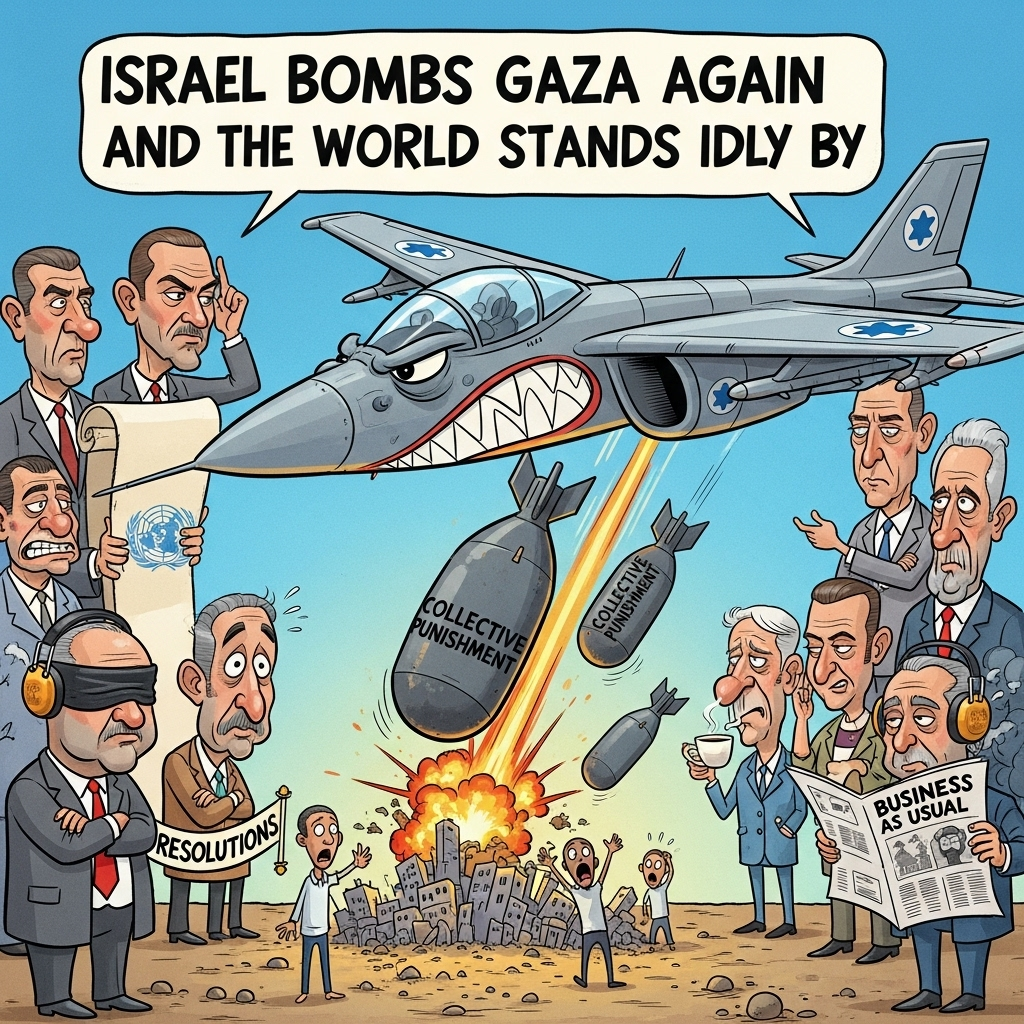
In a scene that seems to repeat itself every year, as if it were an endless form of collective punishment, Israeli forces launched a series of violent airstrikes on the Gaza Strip on the anniversary of the October 7th attack. While Tel Aviv justifies its actions as “self-defense,” civilians in Gaza once again live under fire — without shelter, without electricity, and without hope.
🔹Bombing on a Day of Pain
Israel chose this symbolic timing to carry out its strikes, sparking widespread outrage across the Arab world and beyond — especially since the date marks a tragedy whose wounds have yet to heal. While Israeli media speaks of “military targets,” on-the-ground reports show that residential areas, infrastructure, and even medical facilities were hit.
🔹An International Community Trapped Between Condemnation and Inaction
Western capitals limited their responses to vague diplomatic statements calling for “restraint,” while the UN Security Council once again failed to take a clear stand to stop the violence. Observers describe this stance as “complicity through silence,” as no binding resolutions have been issued to halt the aggression or protect civilians.
🔹A Renewed Humanitarian Catastrophe
According to Gaza’s Ministry of Health, the airstrikes left dozens dead and hundreds injured — most of them women and children. Water and electricity networks were also damaged, deepening the suffering of a population already trapped under a crippling siege that has lasted more than 17 years.
🔹The Voices of the Victims Are Silenced — But the Truth Cannot Be Bombed
Despite attempts to suppress media coverage, images and videos emerging from Gaza continue to reveal the truth: a besieged city standing with dignity despite its wounds, and a people paying the price for an indifferent world and its cold political interests.

 440.095 SRY