

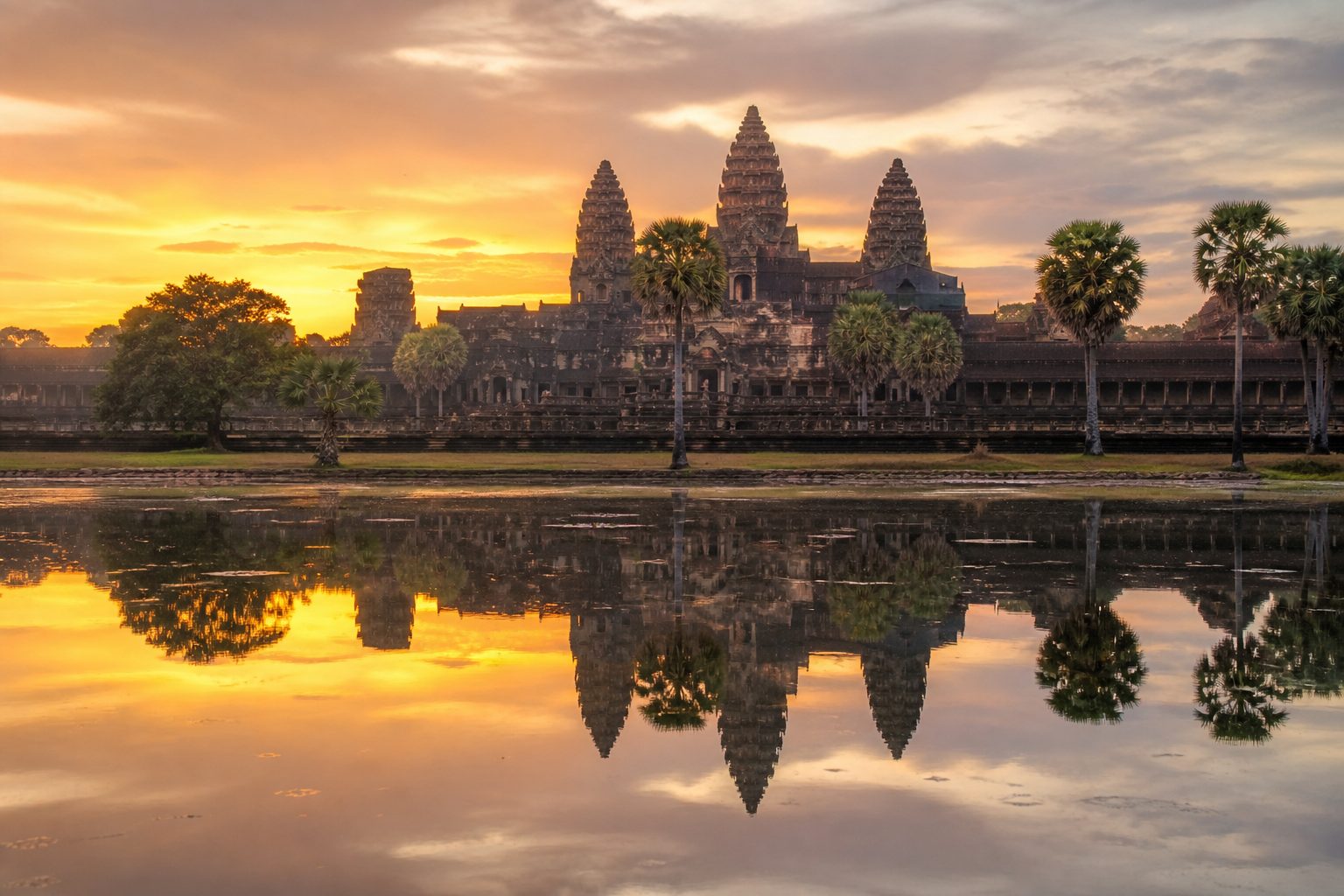
From the 9th to the 15th centuries, the Khmer Empire ruled from Angkor, once among the world’s largest cities. Its god-kings built Angkor Wat and the Bayon, and a vast water system that fed the capital — a legacy still central to Cambodian identity.
The Khmer Empire stands as one of Southeast Asia's most remarkable civilizations, flourishing from roughly the 9th to the 15th centuries. At its height, the empire centered on the great capital of Angkor, a sprawling city that may have been the largest pre-industrial urban center in the world, home to perhaps three quarters of a million people at a time when most European cities were tiny by comparison.
The empire's foundations are often traced to King Jayavarman II, who around 802 CE declared himself a universal monarch and established the cult of the god-king, or devaraja, unifying the region under a centralized power. Over the following centuries, a succession of ambitious rulers expanded Khmer influence across much of mainland Southeast Asia, into present-day Thailand, Laos, and Vietnam.
The Khmer are best remembered for their extraordinary architecture. Angkor Wat, built in the early 12th century under King Suryavarman II, was originally dedicated to the Hindu god Vishnu before later becoming a Buddhist site. It remains the largest religious monument in the world and appears on Cambodia's national flag — one of the few countries to feature a building on its flag. King Jayavarman VII, one of the empire's most celebrated rulers, later built the walled city of Angkor Thom and the Bayon temple, famous for its serene stone faces gazing in every direction.
Underpinning this civilization was a sophisticated system of water management — vast reservoirs (barays) and canals that supported intensive rice agriculture and sustained the enormous population. Many historians believe the eventual decline of Angkor was linked in part to the strain on this water system, alongside shifting trade routes, religious change, and pressure from neighboring kingdoms.
The empire gradually weakened, and after the abandonment of Angkor as the capital in the 15th century, Cambodia entered a long period of decline and foreign pressure. Yet the legacy of the Khmer Empire endures powerfully in Cambodian identity today — in language, religion, art, and the towering temples that still draw visitors from across the world.

 0.000 SRY