

Introduction: Living in the Exponential Age
The pace of technological change is no longer linear; it’s exponential. What was a sci-fi fantasy five years ago is today’s must-have gadget, and tomorrow’s obsolete news. We are living through a simultaneous revolution across multiple fronts: artificial intelligence is gaining a form of reasoning, the physical and digital worlds are merging, and our tools are becoming not just smarter, but more intuitive and ambient. This isn't just about incremental updates; it's about fundamental shifts in how we interact with information, with our environment, and with what it means to be human.
This comprehensive guide is your curated map to the bleeding edge. We will move beyond the hype cycles and marketing fluff to explore the substantive trends truly reshaping our landscape. From the AI engines redefining creativity to the wearable computers making us cyborgs, from the spatial computing that will replace our screens to the sustainable tech that might save our planet—this is your deep dive into the technologies that are defining the present and constructing the future.
Welcome to the frontier of the possible.

Source Convergence: The most powerful trends are no longer isolated but are fusing to create unprecedented new capabilities.
The Intelligence Revolution – AI Gets Personal, Creative, and Everywhere
Artificial Intelligence has graduated from a backend analytical tool to the most dynamic participant in the tech ecosystem. The trend is moving from Artificial Intelligence to Augmented Intelligence—tools that amplify human capability rather than just automate tasks.
Generative AI: The Creative Copilot
The explosion of Generative AI models like GPT-4, DALL-E 3, Midjourney, and Stable Diffusion represents a paradigm shift. This isn't AI that just classifies or predicts; it creates.
- Beyond Novelty: These tools are moving from producing entertaining images and text to becoming integrated professional copilots. Developers use GitHub Copilot to write code. Marketers use Jasper or Copy.ai for first drafts. Designers use AI to rapidly iterate on concepts.
- Multimodal Mastery: The next leap is multimodal AI—single models that seamlessly understand and generate text, images, audio, and video in concert. Imagine describing a scene in text and having an AI generate a storyboard, a script, a soundtrack, and a short film clip, all coherent and aligned.
- The "Chat" as the New Interface: The conversational large language model (LLM) is becoming the primary user interface for complex software. Why click through menus when you can ask your design tool, "Make the logo bigger and change the background to a sunset at a beach"?

Source The AI-Powered Creative Suite: Generative tools are becoming the brainstorming partner and rapid prototyper for professionals.
Small & Mighty: The Rise of TinyML and On-Device AI
While massive cloud-based models get the headlines, a critical counter-trend is the miniaturization of AI. Tiny Machine Learning (TinyML) involves running optimized ML models directly on microcontrollers in edge devices.
- Why It Matters: It enables real-time processing, enhances privacy (data never leaves your device), and works offline. Your smartwatch detecting atrial fibrillation, your headphones applying perfect noise cancellation, your security camera recognizing a familiar face—all happen locally, instantly, and privately.
- Hardware Acceleration: New chips from Apple (Neural Engine), Google (Tensor), and Qualcomm are designed with dedicated AI processing cores, making your phone or laptop a powerful, personal AI hub.
Agentic AI: From Tools to Autonomous Agents
The next evolutionary step is moving from AI that responds to prompts to AI that pursues goals. AI Agents are systems that can be given a high-level objective (e.g., "Plan a full vacation to Japan for my family"), and then autonomously break it down, perform web research, check calendars, book flights and hotels, and create an itinerary.
- The Impact: This shifts AI from a tool you operate to a digital counterpart you delegate to. It promises to automate complex, multi-step workflows but also raises profound questions about trust, oversight, and the nature of work.
The Spatial & Immersive Shift – Beyond the Flat Screen
Our decades-long paradigm of interacting with information on rectangular screens is cracking. The trend is toward spatial computing—interfaces that exist in, and interact with, the three-dimensional space around us.
The Vision Pro Moment: Mainstream Mixed Reality
Apple's introduction of the Vision Pro headset is not about selling a gadget; it's about legitimizing an entire category. It brings mixed reality (MR)—a seamless blend of the virtual and physical—to the forefront.
- The "Infinite Canvas": Instead of being confined to monitor sizes, your apps, browsers, and videos can float anywhere in your living room, resizable and arrangeable. This is a fundamental shift in digital workspace philosophy.
- Personas & Spatial Presence: High-fidelity avatars ("Personas") enable realistic telepresence in meetings, making remote collaboration feel more human and spatially aware than a grid of video calls.
- Developers, Assemble: The true signal is the massive influx of developers now building for this spatial platform, which will accelerate content and app creation exponentially.
The Metaverse Recalibrates
Following the hype bubble, the concept of the metaverse is undergoing a reality check. The trend is shifting from a single, monolithic virtual world owned by one company to interconnected digital experiences with practical utility.
- Industrial & Enterprise First: While consumer metaverses find their footing, industrial applications are thriving. Companies like NVIDIA with their Omniverse platform are creating digital twins of factories, warehouses, and even entire cities for simulation, training, and remote operation.
- Spatial Web Standards: Efforts like the Metaverse Standards Forum aim to create interoperability, so your digital avatar and items can move between different games and virtual spaces—a crucial step for any true "metaverse."
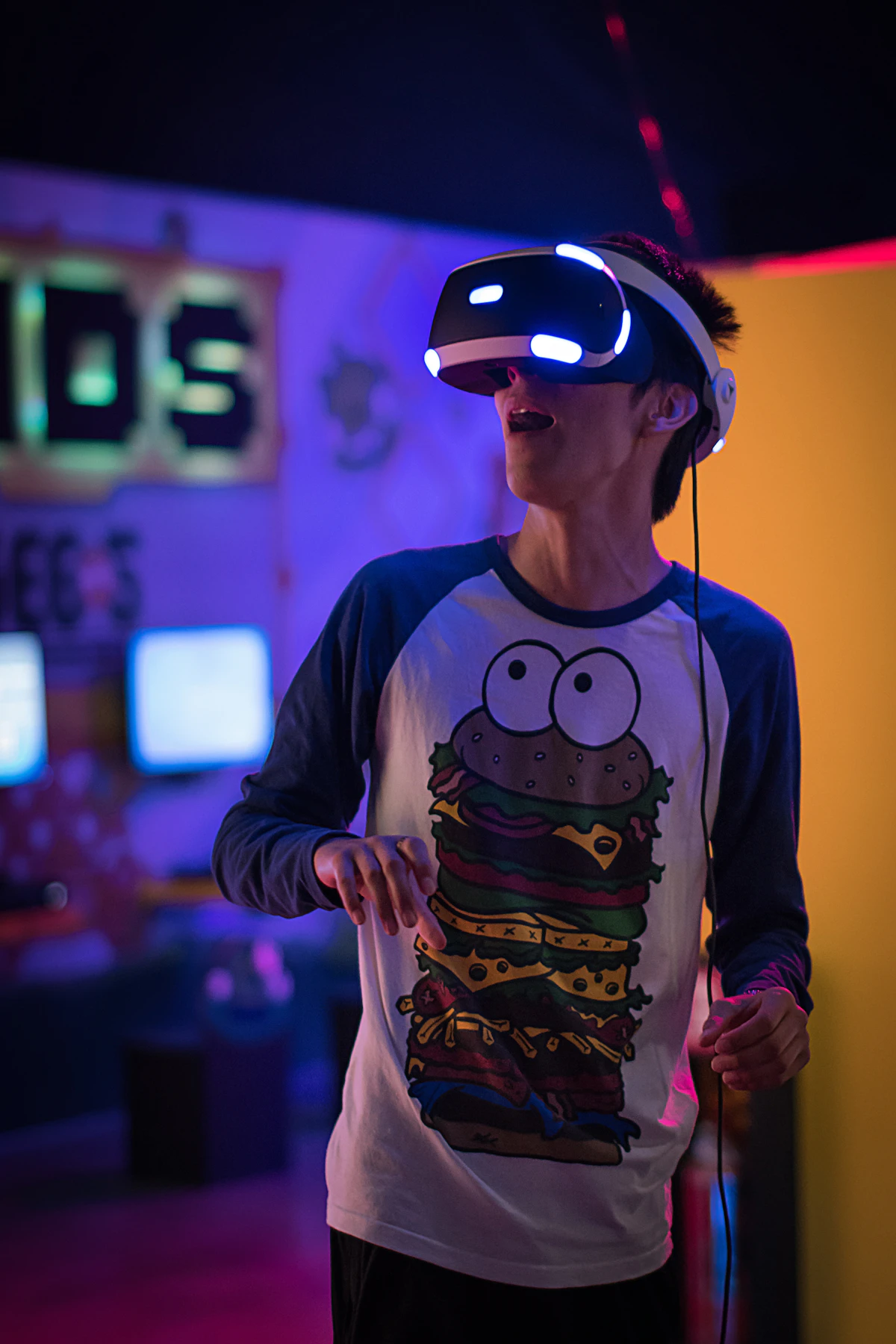
Source The Spatial Interface: Mixed reality headsets are turning any space into a manipulable, infinite workspace.
Haptic Everything: The Touch Revolution
Immersive tech isn't just about sight and sound. The next frontier is haptics—technology that simulates the sense of touch.
- Advanced Controllers: Devices like the bHaptics TactSuit or controllers with adaptive triggers provide force feedback that lets you feel virtual objects.
- Ultrasound & Air-based Haptics: Research labs are developing systems that use focused ultrasound to create tactile sensations mid-air, allowing you to "feel" a holographic button without wearing a glove.
- Wearable Haptic Suits: For ultimate immersion in VR training or gaming, full suits can simulate impacts, weather, and even the brush of a virtual hand.
The Hardware Renaissance – Smarter, More Integrated, More Sustainable
The devices we hold and wear are undergoing a radical transformation, becoming more context-aware, integrated with our biology, and designed with end-of-life in mind.
The Ambient Computer: Disappearing Gadgets
The ultimate goal of technology is to become invisible. The trend is toward ambient computing—where intelligence is embedded in the environment, and devices recede into the background.
- Smart Displays & Surfaces: Devices like the Google Nest Hub or Amazon Echo Show 15 are less about being "tablets on a stand" and more about ambient dashboards for your home, showing relevant info (calendar, weather, notes) only when you glance at them.
- Context-Aware AI: Your devices, working together, will infer your needs. Your car might tell your home you're 10 minutes away, triggering the thermostat and lights. Your morning alarm might not go off if your sleep tracker detects you're in deep sleep.
Brain-Computer Interfaces (BCIs): The Final Frontier
BCIs are moving from medical marvels to potential consumer tech.
- Non-Invasive Breakthroughs: Companies like Neuralink (invasive) get attention, but non-invasive headsets are making faster consumer progress. NextMind (acquired by Snap) and others are developing headsets that can detect neural signals to control devices—think focusing on a virtual button to select it.
- Early Applications: Initial uses are in accessibility, gaming, and meditation/wellness, monitoring focus or relaxation states. The long-term potential—direct thought-to-text communication or controlling augmented reality with your mind—is paradigm-shifting.
The Right-to-Repair & Sustainable Tech Movement
As e-waste becomes a global crisis, consumer sentiment and regulation are driving a crucial trend: sustainable and repairable design.
- Framework Laptop & Fairphone: These are poster children. The Framework Laptop is fully modular, with user-upgradeable ports, memory, storage, and even the mainboard. The Fairphone is designed for easy repair and uses ethically sourced materials.
- Regulatory Push: The EU is leading with laws mandating replaceable batteries and longer software support. This is forcing giants like Apple and Samsung to reconsider sealed designs and short update cycles.
- Circular Economy: Companies are exploring subscription models for devices, where they retain ownership, ensure longevity, and responsibly recycle components.

Source Modularity is Freedom: The push for repairable, upgradeable gadgets empowers users and fights e-waste.
The Software Paradigm Shift – How We Build and Interact
The way software is created, delivered, and experienced is transforming at a foundational level.
The Low-Code/No-Code (LCNC) Boom
The democratization of software creation is accelerating. Low-code/no-code platforms like Webflow, Bubble, Zapier, and Airtable allow non-programmers to build complex applications, websites, and automations through visual interfaces.
- Citizen Developers: Business analysts, marketers, and operations staff can now create their own tools to solve immediate problems, freeing up professional devs for more complex tasks.
- AI-Powered LCNC: The next wave integrates generative AI. Describe the app you want in plain language, and the AI generates the underlying structure in the LCNC platform, bringing ideas to life in minutes.
Everything as an API & Composable Software
The monolithic software suite is breaking apart. The trend is toward composable architectures, where businesses assemble their tech stack from best-in-class, interoperable services.
- API-First World: Every service, from payments (Stripe) to communications (Twilio) to AI (OpenAI API), is offered as a clean API. Developers stitch them together like digital LEGO.
- Superapps & Super Platforms: In Asia, apps like WeChat and Grab started as one thing (messaging, ride-hailing) and became "superapps" by integrating countless mini-programs and services (payments, food delivery, government services) via APIs. This model is now being looked at globally.
The Real-Time Collaboration Layer
Software is becoming inherently multiplayer. The success of Figma (real-time design), Notion (real-time docs/wikis), and Linear (real-time project management) has proven that the best modern software is collaborative by default.
- Presence & Cursors: Seeing your colleague's avatar and cursor live in a document reduces friction and creates a sense of shared space, a lesson learned from Google Docs and now proliferating.
- This Extends to Code: Tools like GitHub Codespaces and Replit allow developers to collaborate on code in real-time, like a Google Doc for programming.
Connectivity & Invisible Infrastructure – The Fabric of the Future
The trends we see are enabled by profound advances in the underlying infrastructure that connects everything.
5G-Advanced & The Road to 6G
While consumer 5G rollout continues, the industry is already looking to 5G-Advanced and early research into 6G.
- 5G-Advanced: This iteration focuses on optimizing for the Internet of Things (IoT), enabling massive sensor networks, improving energy efficiency, and supporting advanced industrial automation with ultra-reliable links.
- The 6G Vision: Envisaged for 2030+, 6G aims to integrate sensing with communication (your network will understand the physical environment), support holographic-type communications, and achieve near-instantaneous latency. It's not just faster data; it's a new sensory layer for technology.
Satellite Internet Goes Global & Mobile
The race to blanket the Earth in broadband from space is heating up, moving from a niche to a mainstream trend.
- Starlink & The LEO Revolution: SpaceX's Starlink, with its constellation of low-earth orbit (LEO) satellites, has brought high-speed, low-latency internet to remote areas. The new frontier is mobile connectivity—service for planes, ships, and eventually direct-to-cell phones (partnering with carriers like T-Mobile).
- New Competitors: Amazon's Project Kuiper is gearing up to launch its own constellation, ensuring this becomes a competitive, vital global utility.
Computing Everywhere: Distributed Cloud & Edge AI
The cloud is no longer "over there." The trend is the distributed cloud—where cloud services are deployed physically closer to where data is generated and used (at the "edge").
- Hybrid AI: Complex AI model training happens in the centralized cloud, but the refined models are deployed to edge servers in cell towers, factories, or even store locations for instant inference. This is key for autonomous vehicles, smart cities, and responsive retail.
- Privacy-Preserving Computation: Techniques like federated learning allow AI models to be trained on data that never leaves your device (e.g., your phone), aggregating only the learned patterns. This marries powerful AI with strong data privacy.

Source The Connected World: Invisible infrastructure of 5G/6G, satellites, and edge computing forms the nervous system of future smart cities and global connectivity.
Conclusion: Navigating the Human-Tech Symbiosis
The trends we see are not disparate threads but part of a single, woven fabric: a movement toward technology that is more intelligent, immersive, integrated, and intuitive. The central theme is symbiosis—a deeper, more seamless partnership between human intention and machine capability.
We are moving from using tools to collaborating with agentic systems. We are transitioning from looking at screens to inhabiting spatial digital layers over our world. Our gadgets are evolving from standalone devices into nodes in an ambient, intelligent network.
The critical challenges accompanying these trends are as defining as the technologies themselves:
- The Ethics of Generative AI: Navigating copyright, disinformation, and economic displacement.
- The Privacy of Immersion: Defining boundaries in a world of always-on sensors and biometric data.
- The Sustainability of Innovation: Ensuring the tech revolution doesn't come at the cost of our planet through resource depletion and e-waste.
- The Digital Divide 2.0: Ensuring access to these powerful tools doesn't create new, more profound societal inequities.
To navigate this horizon, we must be both enthusiastic adopters and critical thinkers. We must embrace the tools that augment our humanity while fiercely advocating for the ethical frameworks, sustainable practices, and inclusive access that will ensure technology lifts all boats. The future is not something that happens to us; it is something we build, one line of code, one mindful purchase, and one ethical decision at a time. The horizon of now is here. Let's build it wisely
Image References (All images sourced from Unsplash):
1. Tech Convergence Abstract:
2. AI Art Generation Workspace:
3. Developer using AI Coding Assistant:
4. TinyML / Microcontroller with AI:
5. Mixed Reality User in Workspace:
6. Industrial Digital Twin / Omniverse:
7. Smart Home Ambient Display:
8. Non-Invasive BCI Headset:
9. Framework Laptop Modularity:
10. E-Waste Recycling Pile:
11. Real-Time Collaborative Design (Figma-style):
12. 5G Tower & Network:
13. Edge Data Center / Server Rack:
14. Quantum Computer Core:
15. Foldable Smartphone Display:
16. Advanced Wireless Charging:
17. Human-Robot Collaboration in Factory:
18. Futuristic Sustainable City:



 2.495 SRY