
This January 24, a new day of the South American Pre-Olympic Championship was held, a tournament that will grant places for this year's Olympic Games.
In the first round, Paraguay beat Uruguay 4-3 in an unforgettable match that featured three goals from Uruguayan striker Luciano Rodríguez.
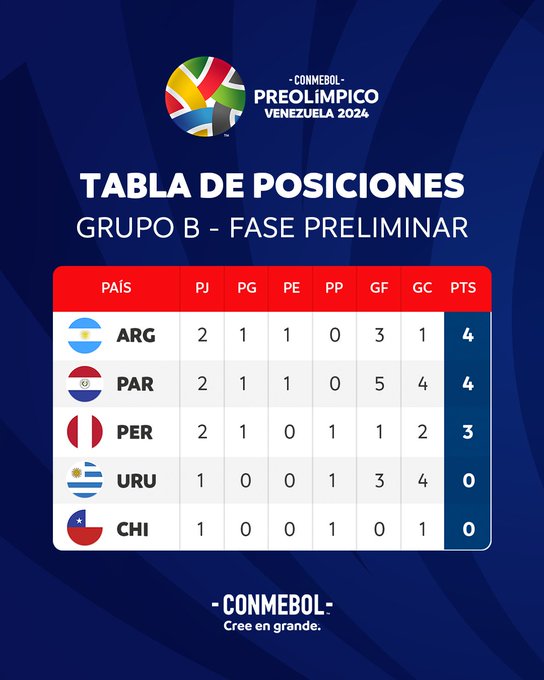
In the second round, Javier Mascherano's Argentine National Team defeated Peru with authority (2-0). Consequently, group B was left with both winners of the day as leaders (the Argentine team is ranked first by goal difference).
Argentina won 2-0 against Peru and climbed to the top of its zone in the Under 23 Olympic Qualifiers.
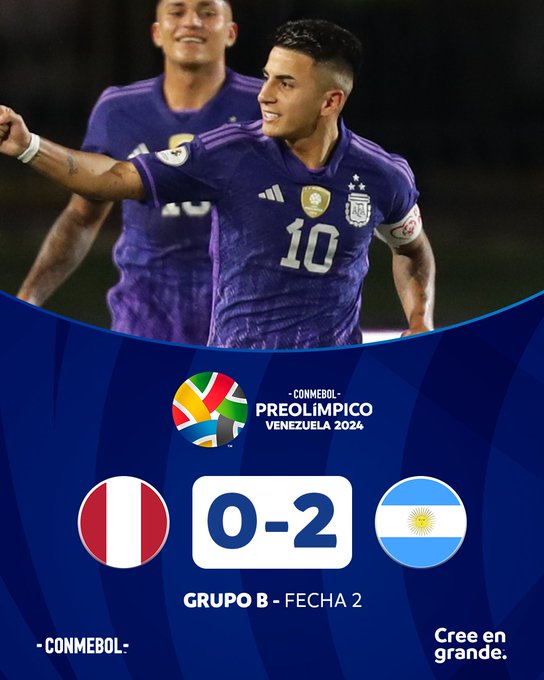
After the last minute draw against Paraguay, the Argentine Under 23 team appeared at the Misael Delgado Sports Stadium with the mission of adding their first victory in Group B of the Pre-Olympic and paving their way to qualifying for the Paris Olympic Games. As in the first round the Guaraní team had beaten Uruguay 4 to 3, Javier Mascherano's team needed to overcome Peru, which in its debut had beaten Chile by the slightest difference.
A controversial decision by referee Vargas, ignoring an alleged penalty by Marco Huaman on Joaquín García and a good partnership formed between Thiago Almada and Cristian Medina that ended with a shot from the midfielder from the mouth into Diego Romero's gloves were the first arguments they presented. albiceleste hegemony. However, the scoreboard remained blank.
Another overflow by Pablo Solari once again complicated the last Inca line, but the greatest concern came when Santiago Castro celebrated the first goal of the night, but the assistant judge annulled the victory due to an alleged non-existent offside. A shame that exposed the limitations of the arbitration authorities. In addition, Mascherano had to replace Marco Di Cesare with Gonzalo Luján due to a muscle injury.
For the complement, the Argentine coach sent Juan Nardoni and Baltasar Rodríguez to the field to try to have more clarity in offensive creation. Juan Sforza and Cristian Medina were the ones who left the field for Racing's leaders. And in the resumption of the lawsuit Solari again demanded Diego Romero after a Peruvian lack of intelligence when he moved from the middle. River's winger continued to appear as the most incisive card in the albiceleste attack.
It was because of Valentín Barco that Argentina had the clearest opportunity to open the scoring. The former Boca full-back anticipated a Peruvian exit, stepped into the area and was knocked down by Álvaro Rojas. An undisputed penalty. Although Colo took the ball because he was the intellectual author of the action, Thiago Almada was the one who took the maximum penalty and celebrated the 1-0 score. A cry that brought calm to the Argentine bench.


Argentina guaranteed the three points in the end after a magnificent collective action that concluded with a great goal from Luciano Gondou. A change of front from Baltasar Rodríguez to Nardoni was the key to dismantling the last Peruvian line. The kids from the Academy got together and Thiago Almada appeared in the center of the area to receive the offload from the former Unión de Santa Fe midfielder. With a lot of solidarity, the talented attacker from Vélez played for the Argentinos Juniors scorer and the skinny with Last in Sarmiento de Junín he sealed the 2-0 to climb to the top of his zone.
The competition system is simple: each team will play four games in the initial phase of the competition and the first two in each zone will advance to the Final Phase. After that, a new group will be created with the four qualifiers and the two with the most points (champion and runner-up) will secure their place in the Olympic Games.
The history of this competition shows that Brazil is the greatest exponent with seven titles in the Pre-Olympics against five for Argentina and one victory for Paraguay. After the 2004 edition, Conmebol changed the classification format and for the three following Olympic editions (Beijing 2008, London 2012 and Rio 2016), places were awarded through the South American Under 20s. For Tokyo 2020 the format was returned usual, with the participation of Under 23 players.
The men's football competition at the next Olympic Games will begin a couple of days before the event's opening ceremony (July 24) and will take place during the two weeks of the event in the French capital. The final for gold will be on Saturday, August 11 and there will be seven venues where there will be Olympic football: Paris, Saint-Étienne, Nantes, Nice, Bordeaux, Lyon and Marseille. It must be remembered that the squad each team will be made up of 18 players.
In the case of the men's event, France has its place assured as organizer of the Olympics. The United States and the Dominican Republic managed to qualify for Concacaf, gaining their place in the Under 20 tournament held in 2022. On the European side, Spain, Israel and Ukraine will participate, the three that achieved passage to the European Under 21 tournament in UEFA that will be played in mid-2023.
Unexpected defeat for Uruguay in its pre-Olympic debut: it won 3-1 and lost 4-3 due to mischief by Paraguay.

Not even the most pessimistic Uruguayan could have imagined at halftime an outcome as disappointing as the debut of Marcelo Bielsa's Celeste in the Under 23 Pre-Olympic tournament, heading to Paris 2024. The thing is that the eastern team, led by Loco, went to rest after starring in a display of good football through their best player: Luciano Rodríguez.
The Uruguayan Liverpool striker surprised the Paraguayan defense with a hat-trick in the initial stage that was of little use to the eastern team, because he did not know how to maintain a two-goal advantage in his favor. With displays of category and hierarchy, the Uruguayans managed to take a 2-0 lead and when Dejesus López scored the discount for the Guaraní representative, Rodríguez once again capitalized on his scoring ability to take the match 3-1 in favor of those from the Río de la Plata .

When Diego Gómez scored again with a magnificent work of art that left Randall Rodríguez with no chance, doubts immediately arose among the performers of La Celeste. And the Albirroja team took advantage of other people's fears through the dead ball. Therefore, at the moment that Marcelo Fernández sealed what seemed like a feat with the 3 to 3, Carlos Jara Saguier's men were not satisfied and went for more.
It was then, when the last quarter of an hour was played, Diego Gómez surprised a defensive lack of concentration from his rival and sealed the 4 to 3 through a free kick that exhibited the mischief of the hero of the day. Since no one had asked for the distance, and the goalkeeper began to adjust the barrier, a decision typical of his inexperience, the Paraguayan looked for the furthest post and achieved the Guaraní victory.
Preolímpico Sudamericano 2024 #4: La cuarta jornada incluyó un partidazo que Paraguay le ganó a Uruguay y el triunfo de la Selección Argentina sobre Perú.

Este 24 de enero se llevó a cabo una nueva jornada del Preolímpico Sudamericano, torneo que otorgará plazas para los Juegos Olímpicos de este año.
En el primer turno, Paraguay le ganó 4-3 a Uruguay en un partido inolvidable que contó con tres goles del delantero uruguayo Luciano Rodríguez.
En el segundo turno, la Selección Argentina de Javier Mascherano venció con autoridad a Perú (2-0). En consecuencia, el grupo B quedó con ambos vencedores del día como líderes (el elenco argentino se ubica primero por diferencia de gol).
Argentina se impuso por 2-0 ante Perú y escaló a la cima de su zona en el Preolímpico Sub 23.

Con goles de Thiago Almada y Luciano Gondou, el equipo de Javier Mascherano le ganó al elenco incaico y alcanzó la punta del Grupo B. En primer turno, Paraguay derrotó 4 a 3 a Uruguay.
Después de lo que significó el empate en el último minuto frente a Paraguay, el seleccionado argentino Sub 23 se presentó en el Estadio Polideportivo Misael Delgado con la misión de sumar su primera victoria en el Grupo B del Preolímpico y allanar su camino hacia la clasificación para los Juegos Olímpicos de París. Como en primer turno el combinado guaraní había superado 4 a 3 a Uruguay, el elenco de Javier Mascherano necesitaba superar a Perú, que en su debut le había ganado a Chile por la mínima diferencia.
Una polémica decisión del árbitro Vargas, al ignorar un presunto penal de Marco Huaman sobre Joaquín García y una buena sociedad conformada entre Thiago Almada y Cristian Medina que terminó con un disparo del volante de boca en los guantes de Diego Romero fueron los primeros argumentos que expusieron la hegemonía albiceleste. Sin embargo, el marcador se mantenía en blanco.
Otro desborde de Pablo Solari volvió a complicar a la última línea incaica, pero la máxima preocupación llegó cuando Santiago Castro festejó el primer tanto de la noche, pero el juez asistente anuló la conquista por un supuesto fuera de juego inexistente. Una vergüenza que expuso las limitaciones de las autoridades arbitrales. Además, Mascherano debió reemplazar a Marco Di Cesare por Gonzalo Luján a causa de una lesión muscular.
Para el complemento, el entrenador argentino envió a la cancha a Juan Nardoni y Baltasar Rodríguez para intentar tener más claridad en la creación ofensiva. Juan Sforza y Cristian Medina fueron los que dejaron el terreno de juego por los referentes de Racing. Y en la reanudación del pleito Solari volvió a exigir a Diego Romero luego de una desinteligencia peruana cuando movió del medio. El extremo de River continuaba apareciendo como la carta más incisiva del ataque albiceleste.
Fue por Valentín Barco que Argentina tuvo la oportunidad más clara para abrir el marcador. El ex lateral de Boca anticipó ante una salida peruana, pisó el área y fue derribado por Álvaro Rojas. Un penal indiscutido. Si bien el Colo tomó la pelota por ser el autor intelectual de la acción, Thiago Almada fue el que ejecutó la pena máxima y celebró el 1 a 0. Un grito que llevó tranquilidad en le banco argentino.
Argentina se garantizó los tres puntos en el final después de una magnífica acción colectiva que concluyó en un golazo de Luciano Gondou. Un cambio de frente de Baltasar Rodríguez para Nardoni fue la clave para desarticular a la última línea peruana. Los pibes de la Academia se juntaron y Thiago Almada apareció por el centro del área para recibir la descarga del ex volante de Unión de Santa Fe. Con mucha solidaridad, el talentoso atacante surgido de Vélez tocó para el goleador de Argentinos Juniors y el flaco con pasado en Sarmiento de Junín selló el 2 a 0 para escalar a la punta de su zona.
El sistema de competencia es simple: cada seleccionado jugará cuatro partidos en la fase inicial del certamen y los dos primeros de cada zona avanzarán a la Fase Final. Luego de eso, se creará un nuevo grupo con los cuatro clasificados y los dos que sumen más puntos (campeón y subcampeón) se asegurarán su lugar en los Juegos Olímpicos.
El historial de este certamen marca que Brasil es el máximo exponente con siete títulos en Preolímpicos contra los cinco de Argentina y una victoria de Paraguay. Luego de la edición 2004, la Conmebol cambió el formato de clasificación y para las tres ediciones olímpicas siguientes (Beijing 2008, Londres 2012 y Río 2016), las plazas se otorgaron a través de los Sudamericanos Sub 20. Para Tokio 2020 se regresó al formato habitual, con participación de jugadores Sub 23.
La competencia del fútbol masculino en los próximos Juegos Olímpicos comenzará un par de días antes de la ceremonia inaugural del evento (24 de julio) y se desarrollará durante las dos semanas del evento en la capital de Francia. La final por el oro será el sábado 11 de agosto y serán siete las sedes donde habrá fútbol olímpico: París, Saint-Étienne, Nantes, Niza, Burdeos, Lyon y Marsella. Hay que recordar que el plantel de cada seleccionado estará compuesto por 18 jugadores.
En el caso del evento de varones, Francia tiene su lugar asegurado por ser organizador de los JJOO. Por la Concacaf lograron clasificarse Estados Unidos y República Dominicana, que accedieron a su plaza en el torneo Sub 20 disputado en 2022. Por el lado de Europa, participarán España, Israel y Ucrania, los tres que lograron el pasaje en el Europeo Sub 21 de la UEFA que se jugó a mediados de 2023.
Inesperada derrota de Uruguay en su debut preolimpico: ganaba 3-1 y perdió 4-3 por una picardía de Paraguay.
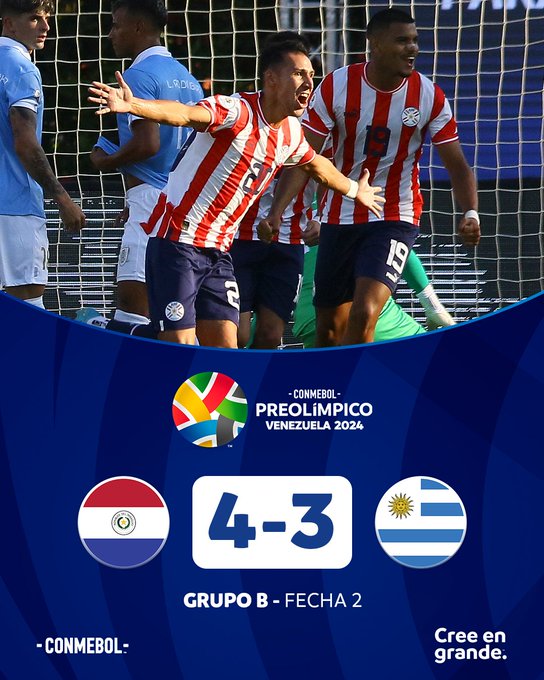
Ni el uruguayo más pesimista se imaginó en el entretiempo un desenlace tan decepcionante como fue el debut de la Celeste de Marcelo Bielsa en el torneo Preolímpico Sub 23, rumbo a París 2024. Es que el combinado oriental, liderado por el Loco, se fue al descanso después de protagonizar una exhibición de buen fútbol a través de su mejor jugador: Luciano Rodríguez.
El delantero del Liverpool charrúa sorprendió a la defensa paraguaya con un hat-trick en la etapa inicial que poco le sirvió al combinado oriental, porque no supo sostener una ventaja de dos tantos a su favor. Con muestras de categoría y jerarquía, los uruguayos lograron ponerse 2 a 0 arriba y cuando Dejesus López marcó el descuento para el representativo guaraní, Rodríguez volvió a capitalizar su capacidad goleadora para llevar el pleito 3-1 a favor de los del Río de la Plata.
Cuando Diego Gómez volvió a descontar con una obra de arte magnífica que dejó sin posibilidades a Randall Rodríguez, las dudas se instalaron de inmediato en los intérpretes de la Celeste. Y el conjunto de la Albirroja se aprovechó de los temores ajenos a través de la pelota parada. Por lo tanto, en el momento que Marcelo Fernández selló lo que parecía una hazaña con el 3 a 3, los de Carlos Jara Saguier no se conformaron y fueron por más.
Fue entonces, cuando se disputaba el último cuarto de hora, Diego Gómez sorprendió una desconcentración defensiva de su rival y selló el 4 a 3 a través de un tiro libre que exhibió la picardía del héroe de la jornada. Como nadie había pedido la distancia, y el arquero se puso a acomodar la barrera, una decisión propia de su inexperiencia, el paraguayo buscó el palo más lejano y concretó el triunfo guaraní.
Serey is a next-generation blockchain-based social networking platform with a cutting-edge Web 3.0 decentralized applications (dApps) ecosystem.
Participate by writing articles, commenting, voting and earn SRY tokens!
Serey es una plataforma de red social basada en blockchain de próxima generación con un ecosistema de aplicaciones descentralizadas (dApps) de vanguardia de la Web 3.0
Participa escribiendo artículos, comentando, votando y gana tokens SRY!


 772.704 SRY