

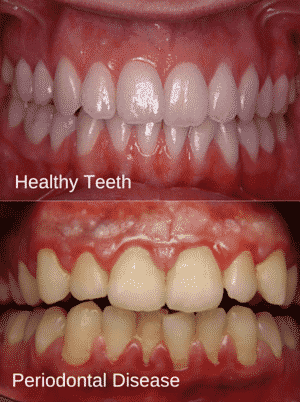
A classification pattern for periodontal diseases for clinicians to clearly assess and treat periodontally affected patients as well as for dentists to bring out cogent results after investigating the etiology, pathogenesis, natural history, and finding lasting solutions to diseases and conditions.
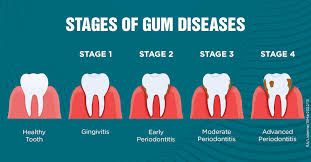
Classification Of Periodontal And Peri‐implant
Diseases And Conditions
A. Periodontal Diseases And Conditions
B. Peri‐implant Diseases And Conditions
Classification Of Periodontal Diseases And Conditions
A. Periodontal Diseases And Conditions
- Periodontal health, gingival diseases and conditions
- Periodontitis
- Other condition affecting the periodontium
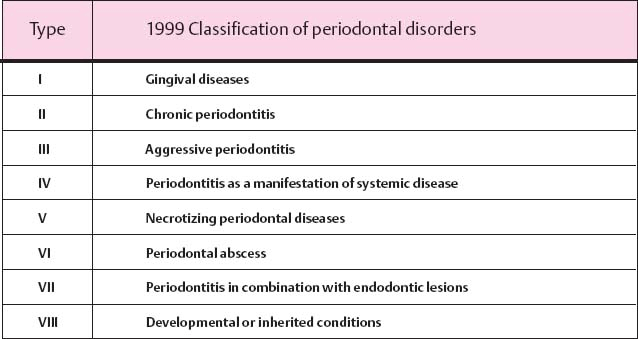
1- Periodontal health, gingival diseases and conditions
I- Periodontal health, and gingival health.
II- Gingivitis: Dental Biofilm Induced
III- Gingival diseases Non-Dental Biofilm Induced
2- Periodontitis
I. Periodontitis
II. Necrotizing periodontitis
III.Periodontitis as a product of systemic diseases influence on the oral structures
3- Other Conditions affecting the Periodontium
I. Systemic factors or parameters affecting the supporting Periodontal tissue.
II. Periodontal abscess and Endodontic Periodontal lesions
III. Mucogingival deformities and Conditions
IV. Traumatic Occlusal Conditions
V. Tooth and Prosthesis Related Factors
Periodontal Health, Gingivitis and Gingival Conditions
Bleeding on probing is the first clinical sign to depict that gingivitis has occurred in an oral cavity. The interesting part is that, patient suffering from gingivitis can revert back to a state of health and wellness but a periodontitis patient remains a periodontitis for life even following successful therapy and also require and need lifelong supported therapy to prevent recurrence of disease.
Periodontal health and gingival health refer to the absence of inflammation associated with periodontitis and gingivitis and it can be assessed both histologically and clinically.
In this classification gingival & periodontal health has been further
classified as :
- Clinical Gingival Health On Intact Periodontium
- Clinical Gingival Health On Reduced Periodontium
- I. Stable Periodontitis patient
- II. Non Stable Periodontitis patient
Definition for a case of Gingival Health on intact & reduced periodontium :
For intact & reduced periodontium and stable periodontium gingival health defined as < 10% bleeding sites with probing depth ≤ 3mm
Gingival Health on reduced periodontium :
Gingival Health on reduced periodontium in stable periodontitis patient is characterized by successfully treatment through control of local and systemic risk factors resulting in minimal ( <10% of bleeding sites) with probing depth ≤ 3mm, optimal improvement in other clinical parameters and lack of periodontal destruction.
Stable : case of successfully treated patient
We should differentiate between stable periodontitis patient and non-periodontitis patient (recession without periodontitis) there is a difference in risk for periodontal disease progression.
Successfully treated periodontitis patient remains a periodontitis patient for life because the disease may progress at any time if periodontal maintenance is less optimal and risk factors are not controlled.
However, at any given time following therapy a periodontitis patient may represent
- a case of health in a successfully treated patient (Stable), or
- a case with recurrent gingival inflammation (BoP ≥10%) at sites with PPD ≤3 mm and no PPD >4 mm (Disease Remission), or
- a case of recurrent periodontitis, where there are bleeding sites ≥4 mm or any PPD is 4mmSzz
That's all as regards this post for this zmoment, more would be touched in the coming posts in furtherance of the explaining different kinds of periodontitis classification. Thanks for the usual attention and unmixed support and happy reading.
Happy Blogging and Reading
Cross posted from my Blurt account

 4408.954 SRY