
Hi Guys!
Pakistan battle in 355-run chase as late breakthrough buoys England
Brook century and trio of wonder-balls give England scent of famous series win
Close Pakistan 202 (Babar 75, Shakeel 63, Leach 4-98) and 198 for 4 (Shakeel 54, Faheem 3) need another 157 runs to beat England 281 (Duckett 63, Pope 60, Abrar 7-114) and 275 (Brook 108, Abrar 4-120)
For the best part of 32 overs, Imam-ul-Haq and Saud Shakeel thwarted an England attack that had been buoyed by a trio of superb deliveries in the first hour after lunch, to take a stiff Pakistan chase down to a potentially gripping fourth-day climax, and keep England's hope of a famous series win on ice for another day … and potentially another Test.
But then, with the shadows lengthening, and England starting to sweat on a route through a doughty 107-run stand for the fourth wicket, Imam leaned into an expansive drive out of the rough against Jack Leach, and scuffed a fast edge to Joe Root at slip to fall for 60 and crank the door ajar once more.
Though Saud Shakeel endured to the close on 54 not out in partnership with Faheem Ashraf, the equation at stumps was simple. Six more wickets for England to take a 2-0 series lead with Karachi still to come, or 157 runs for Pakistan to draw level at 1-1 with their second-highest successful Test run chase of 355.
It had been another gripping day of ebb-and-flow Test cricket, with Pakistan's evening alliance mirroring their free-flowing opening stand of 64 in 15 overs before lunch, in which Mohammad Rizwan - promoted to open after Imam was sent for a scan on a damaged hamstring - and Abdullah Shafique saw off the new ball at a brisk tempo of 4.27 an over.
Prior to that, England themselves had effectively auto-completed their second innings, with Harry Brook's second Test century the highlight of a fast-forwarded hour of batting in which they lost their last five wickets for the addition of 73 runs. Despite the Test still having the best part of nine sessions to run at that stage, England's approach reflected their belief that the surface still had plenty to offer their own bowlers, and - as with their 342-run declaration in Rawalpindi - by leaving Pakistan a nominally feasible target of 355, they would be all the better placed to induce errors.

And, as had also been displayed in that first Test, England possess in James Anderson a trump card every bit as unique as Abrar Ahmed had proven to be in the course of his 11-wicket debut, but also 177 Tests and 20 years more experienced. Now as then, Anderson had been a notable absentee in the opening exchanges, as Stokes held his main man back to exploit the possibility of reverse swing. When he arrived for the first over of the afternoon, he quickly transformed the innings prognosis.
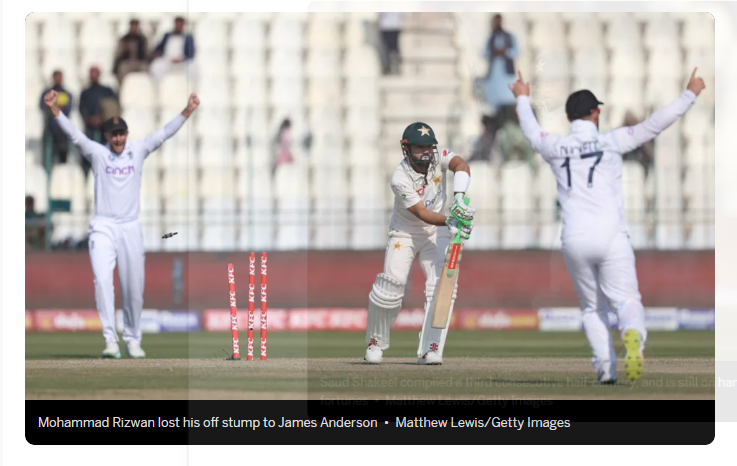
Anderson's first four deliveries of the session were negotiated safely enough, but the fifth was simply unplayable - a full-length seaming delivery that angled in at Rizwan then jagged wickedly around his outside edge to hit the top of off. Rizwan looked dumbfounded as he turned to survey the wreckage, but he had to go for 30 from 43 balls, and England had their opening at 66 for 1.
Leach had been warming up to share the afternoon honours, but Stokes immediately signalled for Ollie Robinson to make it an all-seam attack. In his second over of the session, he too had produced a wonder-ball. With a hint of uneven bounce forcing Pakistan's captain, Babar Azam, to play watchfully against the straight ball, Robinson instead hit the seam a full foot outside off, and Babar, seemingly grateful to be able to leave one, could only look on aghast at the ball zipped back to hit the top of off too.

Shafique all but succumbed to a near-identical delivery in Robinson's next over, but he wouldn't survive for much longer. Stokes rang the changes once more, recalling his quickest bowler, Mark Wood, in the final over before drinks, and with his very first ball, he burst another off-stump rattler through Shafique's defences, again from wide of the crease, but keeping low as it skidded on with extra oomph.
At 83 for 3, Pakistan's innings was pinned to the ropes. But with his notable willingness to save his seamers for the key moments, Stokes instead leaned heavily on his spinners with in-out fields, tempting Pakistan to hit through the phalanx of close catchers. Once again, his first-innings weapon, Jack Leach, was Stokes' most trusted option, but with two left-handers lining him up, Leach endured some rough treatment, going at 4.40 in the course of his 20 overs. Until, of course, he produced the moment that repaid the faith, and unlocked England's prospects of closing out the game.
The opportunities had kept coming regardless, up until that moment - on 4, Shakeel top-edged a slog-sweep off Root that fell short of Wood, set a few metres too deep at midwicket, while on 19, Imam drilled a hard chance back down the pitch at Will Jacks, who couldn't cling on. The biggest let-off, however, came deep into the final session, as Imam, then on 54, flicked his bat at a leg-side lifter but Stokes declined the review that would have shown a faint tickle. It was the slightest indication that England's captain was starting to feel the heat, as Imam and Shakeel grew in confidence with a series of sweetly-timed cover drives, particularly off the then-leaky Leach.
Despite the excitement generated by England's trio of early wickets, England found little in the way of reverse-swing as the innings progressed, on a day-three pitch that was arguably playing at its best. Stokes himself resisted any temptation to break the emergency glass and bring himself on for a spell, although that prospect remains for an intriguing fourth-day finish, when only the draw will be off the table.

In spite of Pakistan's relative success in the morning session, the major milestone had belonged to Brook, who converted his overnight 74 to his second hundred in four innings on this trip. By the time he holed out to deep square leg for 108, Brook had racked up 14 fours and a six in his 149-ball stay, replete with powerful strokeplay and impressive judgement of length, particularly against the spin of Abrar, who was once again Pakistan's most threatening bowler, as he finished with 4 for 120, and an 11-wicket match haul on debut.
Abrar came in for some heavy blows in the first hour, however, with Brook seizing on a series of drags to the leg-side, and Stokes launching the same bowler over the straight boundary for six, to draw him level with his coach Brendon McCullum on 107 Test sixes, the most by any player.
Before he could convert that start into anything more meaningful, however, Stokes got underneath a heave to leg, where Ali on the midwicket boundary ran round for a well-judged catch. Robinson then missed a slog to leg as Abrar skidded a googly through his gate for his 11th wicket, before Wood poked a fast legbreak from Zahid Mahmood to slip and Anderson missed a reverse sweep to wrap up the innings. At that stage, and again after lunch, England were perfectly content with their match situation. By the close, notwithstanding Leach's late breakthrough, they were a touch less comfortable.
Saud Shakeel provides another flicker to Pakistan's ever-guttering flame
History says England have the series in the bag, but Pakistan's exceptions remain their rule

The morning session oscillated delicately between overwhelming English control and the gentlest whiff of a Pakistani opportunity; the dance redolent of a first date where one side is keen to pull away out of sight, even as the other desperately clings on. England were so sure they were steering clear, though, they didn't quite clock Pakistan's power to hang on and drag the dalliance out by at least one more day.
Pakistan's first-innings implosion on Saturday might have seemed tactically baffling. But the pay-off came today as England, lulled into what might still turn out to be a true sense of security, gave away their last five wickets with the profligacy of a billionaire frittering away their fortune on a social media company. It still left Pakistan needing their second-highest fourth-innings chase to level the series, a feat that, even for a city as steeped in the folklore of yesteryear as Multan, would be historic.
But Pakistan draw their belief not from the blind faith they place in their collective process, à la England, but from the occasional jarring exceptions to the general trend of their Test batting decline. There might be collapses aplenty straddling more than just this generation of Pakistan's Test cricket, but like the occasional brilliant flashes of light from a flame that's invariably going out, Pakistan's batting can occasionally sparkle with a luminescence that is no longer characteristic of it.
Since the start of 2014, no other side in the world has chased down totals in excess of 300 as frequently as Pakistan. Just this year, one vintage one for spectacular batting implosions, Pakistan ran down 342 in Galle, and amassed 443 for 7 in Karachi against an Australian attack that had rolled them for 148 48 hours earlier.
Mohammad Rizwan opened the batting alongside Abdullah Shafique after Imam-ul-Haq had been sent for an MRI scan on a dodgy hamstring, and injected the sort of gentle intent that has seen him earn both praise and criticism in the shortest format. Joe Root was dispatched for ten in his first over, Shafique looked particularly comfortable, and as lunch arrived, Pakistan were well placed having scored 64 undefeated runs.
Lunch at the Multan Cricket Stadium strikes a steady balance between bland mediocrity and mediocre blandness, but even a Michelin Star chef would have struggled to leave English fans salivating quite as much as the visitors' newish-ball spell after the interval. With James Anderson, Ollie Robinson and Mark Wood each producing their best deliveries of the series, Saud Shakeel and Imam found themselves in a scrap to take the game beyond the weekend.
Both men have plenty to prove in this format, but Shakeel appreciates that point more than Imam. He had travelled with this Test side from time to time before making his debut in Pindi, but Zahid Mahmood's experience would tell him that earning a reward for patience is no guarantee of success.
He saw off a barrage from England's fire-breathing quicks post-lunch, never once worrying about a strike-rate that was likelier to dip into single figures than rise into three. That temperament demonstrated why Shakeel has the highest control percentage against seam bowling among all Pakistan batters; of the 222 seam deliveries he has faced, he has been in control of 93.24%, edging out his captain Babar Azam at 93.04%.
In the era of Brendon McCullum's England, who sometimes feel as if they've reinvented Test cricket since the summer, it's easy to get carried away, and believe you can fly even if you do not have a magic carpet. The mood even caught PCB chairman Ramiz Raja on Saturday, as he told Sky Sports' Michael Atherton he wanted Pakistan to select T20 players in the Test side to replicate what England were doing.
Saud is not a T20 player. He certainly does not have a magic carpet. But he possesses the maturity to recognise the futility of chasing after toys he cannot afford, and has learned not to lust after them either. In his first 33 balls, he had scored five runs. In his four innings for Pakistan so far, he hasn't once managed a strike-rate in excess of 60. Juxtaposed against England's modern, flashy shotmaking, he feels like a typewriter in the age of the smartphone, and just as exciting.
But he averages in excess of 66 in the fourth innings across his first-class career, and with two days left in this match, it matters little how quickly those runs come. Across this series, no Pakistan player has negotiated pace better. He's unbeaten on 54 off 123 overnight, but that's exactly what he is: unbeaten. Imam might have contributed more runs, and scored them at a greater clip, but a flash at dusk outside off means he won't be worrying England anymore.
Shakeel was called up to make his ODI debut against South Africa in 2021, shortly before being ruled out of the tour with a quad injury, so he'll be well aware of the limited value of a good day in an otherwise rough week. And even when the Sunday Multan crowd - the biggest of the Test by far - witnessed Pakistan enjoy their best day of the series, they would walk away fully aware the bulk of Pakistan's work still lay ahead of them.
Even so, England have been dragged back for another date, the prospect of nothing to separate the two sides as they fly together onto Karachi very much real. The visitors may yet feel they're well placed to escape Pakistan's clutches, but Shakeel's grit, and the contradictory weirdness innate in Pakistan's batting record this year, ensures there'll be plenty of butterflies in English stomachs overnight.
Pakistan, and the curious case of collapsing on flat tracks
It's a curiously Pakistani problem, and even when it isn't, there's still the issue of such pitches masking the brittle nature of a batting line-up in transition

He's bowled 18 overs, this Jack Leach. He's got one wicket for 70. Saud, meanwhile, has looked supremely comfortable in the middle. How many wickets did our man Abrar Ahmed have when he'd bowled 18 overs? Can't remember exactly, but it was a lot more than one. We'll check later, but for now let's enjoy this overwhelming show of batting dominance.
Better up that scoring rate, though, Saud. You're 59 off 104. We didn't have much to do this summer, so we watched the way England bat. We couldn't quite believe it, so we made sure we watched it up close in Pindi. And now we find this sort of scoring rate dull.
Boom! Did you see the way he chipped that over the offside? His use of the feet against this supposedly brilliant spinner who somehow has 99 Test wickets? How did we never notice how harmless he is? Saud's going to do this again, you know. Look, there he goes!
The length was shorter this time, maybe this Leach bloke has a trick or two up his sleeve. Anyway, James Anderson's running after it. He's never getting there, he's so old Pakistan probably wasn't even a democracy yet when he made his debut. Oh, wait, he's got there and caught it?
Well, at least Rizzy bhai's still there, even if his intent is as reliable as a New Year's resolution by the time February rolls around. Come on, Rizzy bhai. We've defended you when people say you're conservative but 6 off 41 balls? By 41 balls, the English start thinking about some chap named Gilbert Jessop. If I never hear about him again, it won't be a moment too soon.
Now we're talking! Did you see that skip down the pitch, that caress back down the pitch, as sleek and powerful as an Italian racecar? But what's this Leach gone and done? He's turned a ball, beaten the edge, and cleaned Rizzy bhai up? It seems to happen a lot to him now, doesn't it?
Those two dismissals might have been very different in style, but they represented something of a sliding doors moment, coming as they did in the space of four overs as the smoggy Multan morning gave way to watery winter sunshine. As Pakistan crept into the ascendancy, Saud Shakeel went after a ball he didn't get to the pitch of and had no control over. Mohammad Rizwan, meanwhile, had played two attacking shots in 42 balls, and Leach had to vary little as he probed with the length ball, searching for the extra grip to beat Rizwan's bat.
They would herald a collapse that saw Pakistan lose seven wickets for 37 runs - more to a slew of inexplicable shots than anything spectacular the bowlers did - thrusting England into an ascendancy they are unlikely to relinquish.
In a way that's amusingly specific to this cricket team, Pakistan somehow find themselves in a situation where they prepare too many flat pitches, and yet also collapse in a heap on them. In the last nine months alone, this side have been rolled over for 148 on a pitch in Karachi on which Australia had managed 556 for 9 declared, collapsed in Lahore from 248 for 3 to 268, and then lost all ten wickets, after being 77 for no loss, on the final day of that game to cede the series to Australia. A similar collapse followed against Sri Lanka on the final day in Galle, where Pakistan succumbed from the relative comfort of 176 of 2 to fold well before stumps for 261. In Rawalpindi earlier this week, on a wicket so moribund the Pakistan head coach Saqlain Mushtaq called it "very flat" and the PCB chairman Ramiz Raja termed it "embarrassing", Pakistan capitulated spectacularly after tea, losing their final five wickets for nine runs.
Multan might have been watching this - Pakistan's latest hit in an album no one asked for - in the flesh for the first time, but by now it's become something of a familiar sight. Azhar Ali's dropping, a decision made on the eve of this second Test, demonstrated Pakistan's recognition that a problem needs solving, but the strength of an omission invariably hinges on its replacement. That is why Asad Shafiq's departure was more easily smoothed over. Fawad Alam came in, showed he belonged - and, ironically, might have been the ideal batter to have in the middle order on a spinning track such as this. Azhar's batting shoes, after all, are giant ones to fill, and his replacement Mohammad Nawaz isn't really geared to filling them anyway.
Rizwan might be like a student in class whose grades you needn't worry about, but concerns are beginning to surface on that front too. The panoply of issues that plague Pakistan's Test side mean the wicketkeeper's form isn't the most pressing, but in his previous 20 innings, he's only managed two scores in excess of 50, and averages 22.88 across his last nine.
Just as damagingly, some of the more benign pitches have masked the scent of decay in a batting line-up experiencing its greatest transition since MisYou collectively walked away. Imam-ul-Haq, despite his average of 54.75 over the past year, remains unproven at this level, with little evidence to suggest dropping him for Abid Ali in 2019 wasn't the right call - and that average is propped up by two legendarily poor pitches in Rawalpindi, without which it drops to the mid 20s.
Abdullah Shafique's inexperience adds another variable to a batting line-up that's increasingly fluid, while the middle order duo of Saud Shakeel and Salman Ali Agha is tasked with carrying a workload recently borne by Azhar, Shafiq and Fawad. It's easy to recall Pakistan's struggles when Misbah and Younis stepped away, and Pakistan will be disquieted by the reminder that Azhar and Shafiq, the princes of Pakistan's middle order, didn't quite step up to replace them as had been originally hoped. And unlike Azhar and Shafiq, there are no princes this time; the line of succession is suddenly barren.
As England tot up a significant lead, it's impossible not to feel the fourth-innings target they set has already broached the territory of the insurmountable. And on days like today in Multan, it's perhaps easier to laugh at it all rather than worry about it.
Jack Leach takes the risks, earns the rewards in embodiment of England's new world
No point in judging spinner by his statistics, but his central importance to team is clear

There is no question Jack Leach is a different bowler under Ben Stokes.
The left-arm spinner is a far more accomplished and braver bowler. Stokes as captain spent the summer reinforcing his confidence with praise and testing his mettle by refusing Leach's requests for boundary-saving fielders. He took the first ten-wicket haul of his Test career in the summer at Headingley against New Zealand, within that coming his first two five-wicket hauls on home soil.
The overall numbers, however, do not reflect the strides he has made this year. Under Stokes, Leach currently averages 40.17, higher than his overall of 33.75, and his 31.88 under previous skipper, Joe Root. Even after his successes in the first innings at Multan, his strike-rate under Stokes remains nine points higher than it was under Root.
Test cricket is the format that judges such stats more harshly than any other, but within the current England set-up - a team with such an absolute focus on winning that its bowlers are happy for their economy rates to go up so long as the opposition's wickets are going the same way - Leach's make for unusually misleading numbers. Even so, on day two in Multan, he finally got a haul that worked in his favour, figures of 4 for 98 in 27 overs that helped established a crucial first-innings lead of 79.
"Don't look at my stats," Leach said, when asked how to disconnect the thriving cricketer from the questionable statistics. "Do you know what, I've never felt this so much - as a team, we just want to win. And we'll do everything we can to do that.
"I really start to understand that we're going to take a few more risks to maybe take a wicket, and that might require going for a few more runs."
There is one piece of data, however, that underlines not just what Leach is doing well under Stokes, but the perseverance that he has required to do it. No spinner has taken a wicket immediately after getting hit for a boundary as many times as Leach. His dismissals of Saud Shakeel and Mohammad Rizwan on Saturday in Multan took him to 12 overall and four under Stokes alone. Moreover, they were Test wickets 100 and 101.
It might seem a little convenient to extrapolate character simply through tuning the dials on Statsguru. And it is, no doubt, though only because the real takeaway is how much thicker his skin has had to become. Leach's story is about plugging away in the face of adversity, whether through his battles with Crohn's disease and the assorted ailments he has picked up as a result, or the professional bumps he has experienced since his debut back in March 2018. Now, 30 caps on, that thick skin is almost a weapon in its own right, especially in the midst of England's new era.
On Friday evening, with Pakistan still trailing by 174 after closing on 107 for 2, England's attack reflected among themselves that they had been cut too often - and Leach himself had been a particular culprit, with a drag-down from the first ball of each of his first two new-ball overs. Returning on Saturday, they reiterated a plan to bowl straighter and force the batters to hit to areas that weren't their first choice, with men waiting in the deep, strategically placed three-quarters of the way to the fence.

Ironically, their key morning breakthrough was nothing to do with this plan. Ollie Robinson, with only his second ball of the match, ripped an inswinger through Babar Azam's defences to take out middle and off. That was the first of eight wickets to fall for just 60 runs, with Leach building on Robinson's momentum by taking the next three.
Saud Shakeel's loft down the ground was followed, one ball later, by a drag to midwicket that James Anderson caught brilliantly running back towards the boundary. Leach had tucked his length back a fraction to force the left-hander to reach a little more than he'd have liked. The dismissal of Mohammad Rizwan, however, was a touch of class mixed with a bit of anger, after Leach had been driven immaculately down the ground.
"It felt good coming out of the hand, definitely," Leach said of a delivery that pitched on leg and took middle. "He'd just hit me for four over the top so I maybe tried to put a little bit more on that one. And when he went back, I thought, that's good, I might have him in a bit of trouble." He did.
Mohammad Nawaz then chipped Leach to a gleeful Stokes at a catching mid-on, taking him to 103 wickets with plenty prospects of improving that figure before the Test is out.
There was plenty generosity of that type on offer from Pakistan's batters. But even so, from the drying-up of scoring opportunities to the subsequent clatter of wickets, it took a rare level of collective confidence to take such assured control of the game. And on a red-letter day for Leach, he was not only the main exponent, but for once the main beneficiary.

 77.803 SRY