
Hi Guys!
Hasan Ali in line for Pakistan return as Haris Rauf replacement
Pakistan looking to add experience to fast-bowling options for Multan Test
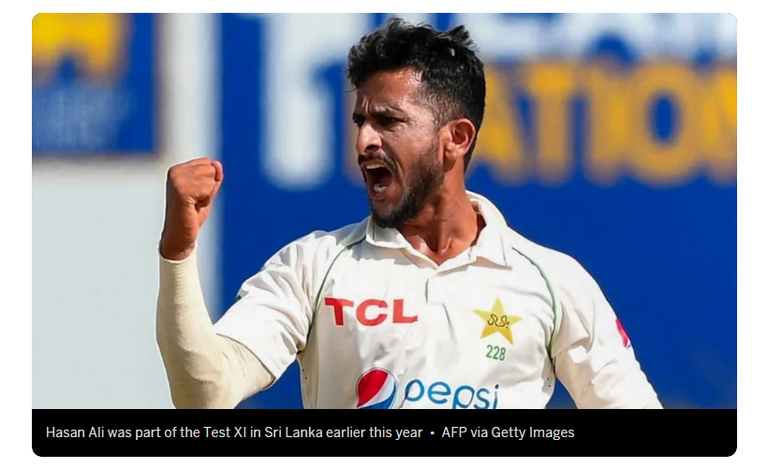
Pakistan are likely to call up fast bowler Hasan Ali to the Test squad to replace Haris Rauf, who has been ruled out of the rest of the England series with a quad injury. Rauf was injured while fielding during England's first innings in Rawalpindi, leading to a grade two strain in his right quad.
ESPNcricinfo understands Pakistan will call upon a fast bowler from outside the original 18-person squad for the second Test, starting in Multan on Friday. The only specialist fast bowler who didn't play the first Test for Pakistan was Mohammad Wasim Jnr. But Wasim Jnr is yet to play a Test match, while three of the four bowlers who played the first Test in Rawalpindi were also making their debut, and adding some experience to the attack is seen as desirable.
Hasan was one of the first names on the Pakistan team sheet until recently, having been named Pakistan's Test Cricketer of the Year for 2021. However, his tendency to hit form in streaks makes him a somewhat less reliable bowler for the Test side, and his red-ball numbers over the past year have dipped sharply. He played against Sri Lanka in July but was dropped for the England series, and his 14 wickets in the recently completed Quaid-e-Azam trophy for Southern Punjab came at 40 runs apiece.
However, his experience with the national side - he made his Test debut in 2017 and has played 21 Tests - will bolster a bowling line-up that is particularly wet behind the ears. In addition, his high ceiling potentially provides an X-factor that a Pakistan bowling line-up without Shaheen Shah Afridi arguably lacks.
Mohammad Abbas is another option, even if his line-and-length medium pace makes him an unsuitable like-for-like replacement for the injured Rauf. ESPNcricinfo understands Abbas has not yet been contacted, though an impressive Quaid-e-Azam trophy season - he took 18 wickets at 24.16 for Sindh - could make him an attractive option. In the first Test, Pakistan opted to play Mohammad Ali, a similar bowler to Abbas, though he had a debut to forget.
Babar Azam: 'We didn't get the pitch we wanted'
Pakistan captain backs team - and selection - after being swept aside in first Test

Babar Azam added his name to the growing number of people to express disillusionment with the Rawalpindi surface in the moments after England's famous win in the fading light. As the fallout from the preparation of the pitch intensifies, the Pakistan captain, speaking at the post-match press conference, said he didn't get the pitch he wanted, and that it inhibited the way Pakistan went about their game.
"We have a lot of input in the pitch, but we didn't get the pitch we wanted," Babar said. "We couldn't execute our plans. We wanted a turning pitch, but perhaps because of the weather and preparation, that sort of wicket couldn't be created.
"We are feeling very disappointed as a team. We had an opportunity to win the match. We were in the match the way we started. The way the batters built partnerships after lunch, we were quite confident. But then back-to-back wickets fell and when the new batters came in they struggled. That put pressure on us, but we need to give credit to England the way they fought and put in a real effort."
Pakistan found themselves in comfortable, if not commanding, positions on a number of occasions across their final innings. When the fourth day drew to a close, Imam-ul-Haq and Saud Shakeel had put on 54 for the third wicket partnership and went in unbeaten overnight, looking in complete control against both seam and spin. On the final day, Pakistan went from the relative luxury of 176 for 3 and 259 to 5 to the poverty of losing their final five wickets for nine runs.
"We're not able to finish well when the opportunity presents itself," Babar said. "When we get close to winning, we make some mistakes and end up failing to finish a game off.
"After tea, when Agha [Salman] and Azhar Ali got out, it became evident things were slipping away. Naseem [Shah] and Mohammad Ali dragged it to the very end, but we shouldn't have left it to the tailenders; our specialist batters should have won it."
Aside from the pitch, Pakistan's team selection was the most contentious issue, with the home side handing out four debut caps and deciding against playing an allrounder. That backfired when Haris Rauf was unavailable to bowl in the second innings, leaving Pakistan a pace bowler light, without the option of a seam-bowling allrounder like Faheem Ashraf to bridge the gap. In addition, Pakistan opted to go for Zahid Mahmood over fellow legspinner Abrar Ahmed, despite the latter enjoying significantly more domestic success this season, a decision made to reward Zahid's greater experience travelling with the team.
Babar, however, was unwavering in his support for the team Pakistan put out, and unwilling to accept criticism of the implications it had for either balance or experience.
"In our view we played the best XI. I'm happy with the XI we selected. We planned for this match and played the best XI we had. I don't have any regrets with selection. Every side has its own way and ours is different. You can't change your style suddenly and start playing the way the other side is playing. You have to play according to the situation, when to attack and when to defend. Everyone has their own plans and we try according to our plans. We planned to win. This wasn't a match to draw, but a match to win. It was in our hands, after all."
Even England's teatime declaration on day four, which seemed to have taken everyone by surprise, appears not to have caught Babar off-guard. "We expected them to play such cricket," he said. "They played a similar style during their home series so we knew what to expect. We planned to play a similar brand in some ways but it can get difficult to stop a team scoring at 6.50. We didn't bowl in the right areas at times, and got punished. They took the game away from us in the first innings. In the second innings we bowled on one side of the wicket and got wickets early. But credit goes to the way Joe Root and Harry Brook played in the second innings, because that was outstanding."
He also had warm words for the crowd at the Rawalpindi stadium, which heaved with fans across the weekend, and even on Monday, right until the final moments. That despite the dreary nature of the surface, with little realistic hope of a result until England forced the issue on the penultimate evening. The atmosphere had the air of an intimate gathering rather than a hostile cauldron, with plenty of support for Pakistan and about as much gratitude for England's visit.
"They've given support to both teams," Babar said. "It was packed all five days. When you have a home crowd behind you and show the world that Pakistan cricket is alive and well, and they want other teams to come here too, that feels quite special.
"The Pindi crowd has never disappointed us."
On the merits of Pakistan's performance, though, it would be incredibly generous if the crowd felt the same way about the cricket side they had come to see.
Pakistan's craven conservatism no match for England team on a mission
Determination not to lose at all costs defeats the purpose of inviting the big teams to play

It was a scene of high comedy, and yet also the most succinctly damaging assessment of where Pakistan's Test cricket sits. With half an hour to go in the Test and the sun sinking rapidly beneath the Shoaib Akhtar Enclosure, No. 11 Mohammad Ali decided to pop off to the bathroom, timing it to coincide with the end of the final drinks break, desperate to drain a few more seconds out of this Test match.
As fourth umpire Asif Yaqoob frogmarched Ali swiftly back to the middle as England waited impatiently to finish Pakistan off, the optics were brutal: Pakistan would literally rather hide in the toilet than set up to win a Test match.
Early winter had just crept in and cricket season was starting. The square at Rawalpindi Cricket Ground was just about ready, having seen off a first-class season that offered an engrossing contest between bat and ball. This was the first time this particular strip would be used for a Test match since the format returned to Pakistan in 2019, and it couldn't look readier. There was enough grass on this wicket to suggest lessons had been learned from the debacle nine months ago, when this venue had accumulated 1,177 runs and one demerit point.
The next morning, the England contingent landed at Islamabad airport from their training base in Abu Dhabi to presidential-style security and cordoned-off roads. Amid the frenzied activity around the visitors, it was easy to miss something equally significant taking place at the place they'd spend much of the next week. By the time they arrived at the cricket ground, there wasn't a blade of grass to be seen on the surface.
Over the next five days, England ensured Pakistan were left as nakedly exposed as the pitch they had prepared. Showing what was possible even in the most unconducive conditions, England found one more move every time it seemed Pakistan had set them up for stalemate.

When Pakistan pushed their field out, England simply hit it over them. When Pakistan looked to shut up shop, England brought their fielders up so close it would have breached 2020's social distancing guidelines. When the ball didn't swing, England scuffed it up by thumping it short into the lifeless surface, reaping the rewards with late movement on the fifth afternoon. No sooner had Pakistan found a hiding place than England flushed them back out yet again. Pakistan took every precaution to prevent what they feared would be a humiliating defeat, and yet, the victory England conjured up was more chastening than any three-day thumping could have been.
Pakistan have spent the best part of two decades trying to lure the big teams, or the "Western bloc", as Ramiz Raja pointedly put it last year, back home. So when a deal was struck that saw Australia, England and New Zealand agree to play Test cricket in Pakistan in the space of ten months, it was more than either fans or administrators could have imagined in their wildest dreams just a few years earlier. Since then, however, the surfaces Pakistan has prepared for these series would make younger fans in Pakistan wonder what they'd been missing anyway. What was the point of playing at home against the best teams if it was deliberately designed to be the worst possible spectacle?
Before being appointed chairman, Ramiz had one of the most-followed YouTube channels in Pakistan, known for regularly entreating the side to play with more daleri (bravery) and lambasting them when they didn't. That fiery, truculent attitude was reflected in his first press conference since becoming chairman, and he cannot be accused of changing his tune in the following months.
Repeatedly, however, this Pakistan side under the stewardship of Ramiz, Babar Azam and this team management have shown that they're willing to wound, but afraid to strike. The neutralisation of the first Test against Australia could be justified to some extent, what with Australia's pace battery and Pakistan missing key fast-bowling personnel. But the three Tests that followed have shown it up for the cravenly conservative template that it was, rather than the shrewd tactic the team management wanted us to believe.
Australia is a kind of mythical sea-monster for Ramiz, anyway, one to be spoken of in hushed tones rather than competed with in full flow, but against an England side whose seam attack posed none of the same menace, Pakistan could not find the daleri within themselves to compete on even terms.
Bazball might be as tired a cliché as daleri, but at least England actually stay the course with it. Pakistan spent the previous evening insisting they were here to win this match, suddenly finding their voices after England's munificent declaration seemed to take a draw out of the equation.
But on the fifth morning, that Pakistan talk of victory felt increasingly like a fever dream. Out there in reality, they spent the first 14 overs scoring just 13 runs, with England bowling eight maidens in the 12 overs before drinks. James Anderson and Ollie Robinson kept the pressure, and the field, up, while Pakistan blocked, nudged and left. They had made clear they wanted nothing less than a draw from this match, and despite England's best offers, nothing more than that, either. If ever there was an exhibition of contrasts - in style, philosophy and ambition - this Test was it.

It isn't just the chairman though. Babar Azam's own penchant for conservatism, much like his presence in the Pakistan side, straddles all three formats. Mohammad Yousuf was already in Multan today, apparently to have a chat with the pitch curator. Saqlain Mushtaq is likely figuring out how to balance the scales of cosmic justice rather than balance the team he improbably finds himself in charge of. The circlejerk of enablement is complete.
Even when Pakistan took control of individual passages of play, England recognised them for the aberrations that they were. With Azhar Ali, a man living on borrowed time anyway but the only recognised batter standing between England and an inexplicably long Pakistani tail, England brought one more fielder up. When he did fall with the job unfinished - as he was destined to, perhaps, as his career drags towards its unseemly close - Pakistan's defences were fatally breached.
Soon, England would have 11 fielders close to the bat as they scrambled to triumph in a game Pakistan had tried to ensure was unwinnable (but more importantly, unlosable). Rawalpindi might be a stone's throw from the seat of power in Pakistan, the place where every decision that matters to this country is made. But it was Ben Stokes' men who felt at home against a Pakistan set-up that, at present, barely seem able to comprehend England's philosophy, let alone replicate it.
England were the ones struck down by illness before the start of this Test, but the malaise that afflicts Pakistan shows no signs of being short-term.

 77.797 SRY